

GEO Instead of SEO: How SMEs Stay Visible in ChatGPT, Perplexity & Google AI Overviews in 2026
In 2026, your most important customers no longer type their questions into an empty Google search box. They ask ChatGPT, Perplexity or Google AI Overviews – and get back a finished answer that mentions a handful of vendors. The question is no longer "are we ranking on page one?", but: are we mentioned in the AI answer at all? This guide shows what Generative Engine Optimization (GEO) really means, which seven steps an SME can ship in 30 days – and why classic SEO is no longer enough in 2026, but also not obsolete.
of all informational queries in 2026 are answered by AI engines – not by classic result lists.
of Google searches today display an AI Overview above the classic blue links.
higher chance of being cited for content that was updated within the last 30 days.
What is Generative Engine Optimization (GEO)?
Generative Engine Optimization (GEO) – sometimes called Answer Engine Optimization (AEO) or LLM SEO – is the discipline of preparing content so that generative AI search engines cite it directly inside their answers. Where classic SEO optimizes for a high rank in a result list, GEO optimizes for being part of the generated answer itself – ideally with your brand, your link and your key statement woven into the response.
Sounds like a detail? It isn't. Whoever appears in the AI Overview, in the Perplexity answer or in ChatGPT's research mode gets the traffic that used to go to positions 1–3. Whoever doesn't appear loses it – even if their classic Google position hasn't changed.
SEO vs. GEO: What actually changes
| Dimension | Classic SEO | Generative Engine Optimization |
|---|---|---|
| Goal | Ranking position in the result list | Citation inside the AI answer |
| Success KPI | Position, click-through rate, organic traffic | Share of citations, brand mentions in answers, referrals from AI engines |
| Key crawlers | Googlebot, Bingbot | GPTBot, OAI-SearchBot, PerplexityBot, ClaudeBot, Google-Extended |
| Content style | Keyword density, long-form, internal linking | TL;DR answers, Q&A blocks, tables, original numbers, sources |
| Structured data | Nice-to-have for rich results | Mandatory – Article, FAQ, HowTo, Product make statements machine-unambiguous |
| Freshness | Important, but moderate | Very important – content updated within 30 days is cited 3.2× more often |
Why GEO is no longer "for later" in 2026
Three shifts come together in 2026 and turn GEO from a nice-to-have into a must:
- AI Overviews are the new default. Google shows a generated answer above the classic links on roughly 60 % of result pages. If you're not cited there, you're effectively invisible.
- ChatGPT & Perplexity are research-standard. Over 800 million weekly ChatGPT users, plus an entire generation of decision-makers who open Perplexity first instead of Google – also in B2B.
- Classic search traffic is sliding. Information-heavy industries report 20–40 % drops in organic Google traffic – almost mirroring the growth of AI answers.
The good news: AI engines index new content much more aggressively than Google. If you start now, you typically see your first citations within 2–6 weeks – not six months as with classic SEO.
The 7-step plan: shipping GEO in 30 days
This sequence has held up consistently in our customer projects. You can run it as a four-week sprint without modification.
1. Allow AI crawlers (day 1)
The first and most common blocker: many company websites accidentally block AI crawlers in their robots.txt, because the default CMS rule disallows everything except Googlebot. Explicitly allow: GPTBot, OAI-SearchBot, PerplexityBot, ClaudeBot, Claude-Web, Google-Extended and Bingbot. If you want to block training but stay searchable, block GPTBot but keep OAI-SearchBot open – the latter indexes for search, not for training.
2. Topic clusters with answer pages (day 2–7)
For each core topic, build one hub page plus 3–5 sharp answer pages. Each answer page should resolve exactly one user question – ideally in the first paragraph, in fewer than 80 words. AI engines read the first 200 words disproportionately. Putting clear statements there meaningfully increases citation rates.
3. TL;DR, tables, numbered lists (day 8–12)
AI engines love condensed structure. Every answer page should have: a 2–3 line TL;DR box at the top, at least one comparison table, an FAQ section with real questions, and a numbered "how to do it" list. In tests, these elements double the citation probability.
4. Original statistics & experience (day 13–18)
Engines prefer sources with original numbers. "In our projects we see 30–50 % time savings on lead triage" is roughly 10× more citation-friendly than "AI can save time." Per topic cluster, gather at least three original numbers, customer examples or experience snippets – with clear source and date.
5. Roll out Schema.org markup (day 19–22)
At minimum: Article, FAQPage and HowTo on every answer page; Product on product pages; Organization globally. Schema.org turns "text on a page" into a "structured statement" – and statements get cited by AI engines much more precisely. Validate with Google's Rich Results Test.
6. Strengthen E-E-A-T signals (day 23–26)
Experience, Expertise, Authoritativeness, Trust – AI engines overweight trust signals because they need to avoid hallucinations. Concretely: an author box with photo and LinkedIn link, a full imprint, an About page with real humans, external mentions (press, podcasts, guest posts) and consistent brand naming across all channels.
7. Measure & iterate (day 27–30)
Define 20 core prompts a dream customer would type. Test them once a month in ChatGPT, Perplexity, Gemini and Claude and log whether your brand, URLs and key statements get mentioned. Tools like Profound, Otterly or Peec AI automate this. Pragmatic starting point: a plain Google Sheet is enough for the first 90 days.
What the engines weigh differently
GEO is not a flat playing field. Each engine has its own preferences – understanding them lets you optimize more precisely:
| Engine | Favors | SME lever |
|---|---|---|
| ChatGPT Search | Domain authority, readability, clear statements | Consistent topical focus, author profiles, backlinks from your niche |
| Perplexity | Freshness, word count, structured answers | Frequent updates, TL;DR boxes, FAQ sections |
| Google AI Overviews | Classic SEO signals plus Schema.org and E-E-A-T | Clean technical SEO base, FAQ markup, author boxes |
| Claude | Multiple sources, balanced, non-promotional language | Pros/cons sections, source references, neutral tone |
| Gemini | Google-index signals, fresh content, structured data | Same playbook as Google AI Overviews – exploit the overlap |
The 5 most expensive GEO mistakes for SMEs
- Accidentally blocking AI crawlers. CMS defaults or security plugins often allow only Googlebot. That makes you invisible to ChatGPT, Perplexity and friends.
- Just relabelling SEO. Slapping "GEO" on existing content is not enough. TL;DR, tables, original numbers and Schema.org actually need to ship – otherwise citation rates stay flat.
- Inconsistent brand naming. If your site says "Lyron AI", your imprint says "Lyron AI GmbH" and your LinkedIn says "Lyron", you confuse AI engines. Consistent naming is essential.
- Optimizing once and stopping. AI engines reward freshness. Pages not touched every 30–90 days lose citation share – even if their content is still correct.
- No measurement. If you don't know which answers cite you today, you can't decide what to fix tomorrow. 20 monitored prompts per month is the absolute minimum.
GEO at a glance
| Week | Focus | Success signal |
|---|---|---|
| Week 1 | Crawler access & topic clusters | robots.txt clean, topic map with hubs and answer pages is live. |
| Week 2 | TL;DR, tables, original numbers | Every core page carries a TL;DR, at least one table and three original stats. |
| Week 3 | Schema.org & E-E-A-T | Article-, FAQ- and HowTo-markup live, author boxes and imprint clean. |
| Week 4 | Measure & iterate | 20 monitored prompts documented; first citations visible in at least one engine. |
Conclusion
GEO isn't a trendy SEO add-on. It's the logical consequence of the fact that, in 2026, the input box many of your customers reach for is no longer Google – it's ChatGPT, Perplexity or an AI Overview. SMEs that invest 30 days into a clean GEO sprint – allow crawlers, build topic clusters, add TL;DRs, ship original numbers, roll out Schema.org, strengthen E-E-A-T, measure – secure visibility in exactly the moment when competitors are still reading their old SEO reports. And unlike classic SEO, you'll usually see your first citations in weeks, not months.
Frequently asked questions
What is Generative Engine Optimization (GEO) and how does it differ from SEO?
GEO is the practice of optimizing content for generative AI search engines such as ChatGPT, Perplexity, Claude, Gemini and Google AI Overviews. Where classic SEO targets a high position on a results page, GEO targets being cited directly inside the AI-generated answer – ideally with your brand, link and key statement.
Does GEO replace classic SEO – or does it sit on top of it?
GEO doesn't replace SEO, it extends it. Clean technical fundamentals, fast load times and strong content remain mandatory. GEO adds: TL;DR answers, clear question-answer structure, original numbers, Schema.org markup and open access for AI crawlers. Doing only classic SEO in 2026 makes you invisible in AI answers; doing only GEO costs you the classic Google traffic that still exists.
How important is GEO for a B2B SME?
Very. AI engines now serve an estimated 12–18 % of all informational queries in 2026, and that share is often higher inside B2B research workflows. Decision influencers ask ChatGPT and Perplexity for vendors, comparisons and experiences. If you're not mentioned there, you don't make the shortlist.
Which AI crawlers should I allow in robots.txt?
The most important AI engines today rely on GPTBot and OAI-SearchBot (OpenAI/ChatGPT), PerplexityBot, ClaudeBot and Claude-Web (Anthropic), Google-Extended (Gemini, AI Overviews) and Bingbot. If you want to be cited in AI answers, don't block these crawlers in robots.txt – that's the single most common SME mistake.
How do I measure whether I'm cited in ChatGPT, Perplexity or Google AI Overviews?
Specialist tools like Profound, Otterly, Peec AI or AI Search Grader automate the check across thousands of prompts. A pragmatic start: define 20 important prompts in your topic, run them once a month in ChatGPT, Perplexity, Gemini and Claude, and log whether your brand, URLs or statements appear.
How long does it take for GEO work to show results?
Faster than classic SEO. We typically see first citations within 2–6 weeks because AI engines index new content much more aggressively than the classic Google index. Reliable visibility across multiple engines takes 3–6 months of consistent work.
Visible in ChatGPT, Perplexity & AI Overviews in 30 days
In a free intro call we look at your current AI visibility together: who cites you today, who doesn't, and which three steps move the needle most for you. Includes a live check of your robots.txt and a quick probe of your top topics across ChatGPT and Perplexity.
Book a free intro callShare this article:
More articles
From AI Pilot to Production Agent: The 90-Day Plan for SMEs in 2026
70 % of AI pilots never reach production. This battle-tested 90-day plan shows SMEs how to turn a pilot into a production-ready AI agent.
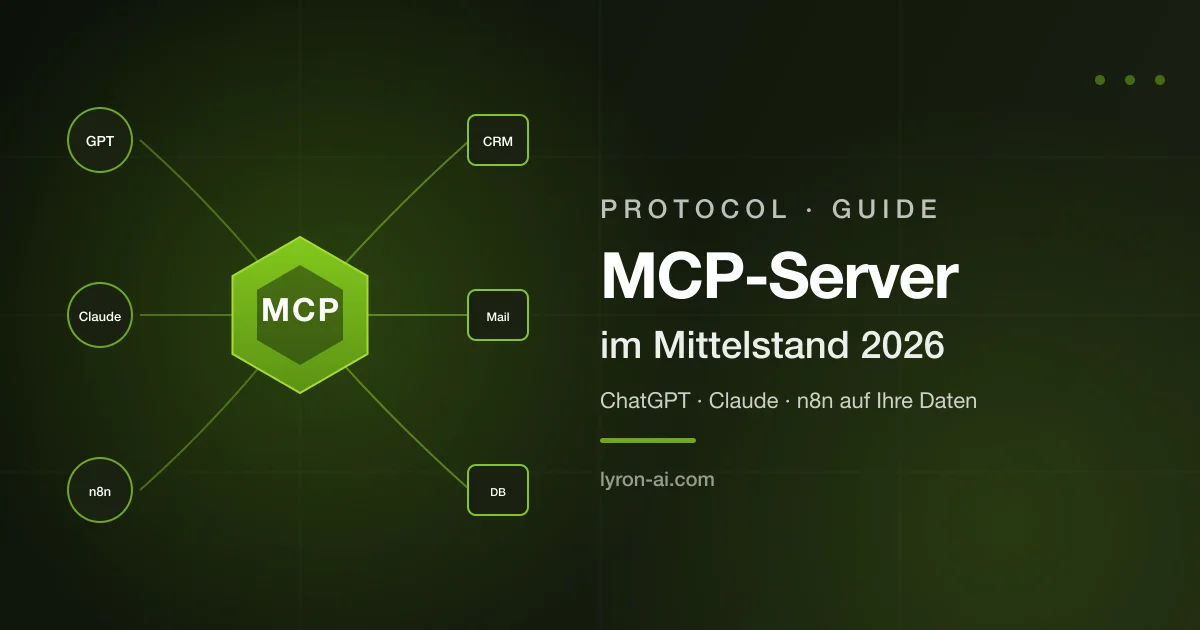
MCP Servers for SMEs in 2026: ChatGPT, Claude & n8n on Your Data
How SMEs connect models and tools through the Model Context Protocol – architecture, use cases and a realistic 4-week plan.

EU AI Act in Practice: What SMEs Need to Do Now in 2026
Risk classes, documentation duties and a pragmatic compliance path for mid-sized automations.