
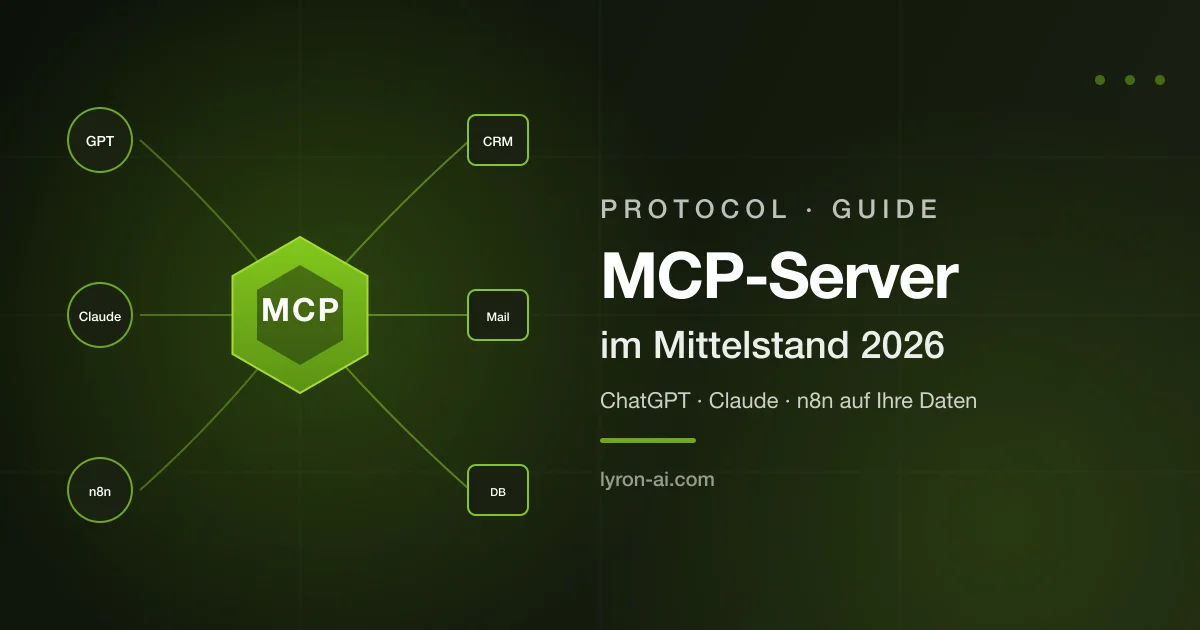
MCP Servers for SMEs in 2026: How ChatGPT, Claude and n8n Finally Connect to Your Data
Anyone running AI agents seriously in 2026 hits the same wall sooner or later: the model is smart, but blind. It doesn't know your CRM, can't tell who called last week, and can't open the order status. This is exactly where the Model Context Protocol – or MCP for short – comes in. This guide explains why MCP servers may be the most important infrastructure step SMEs take in the next twelve months, and what a realistic on-ramp looks like.
What MCP is – the honest short version
MCP is an open standard that describes how an AI model talks to tools, data sources and actions outside its own context window. Anthropic published the protocol in late 2024; today it's supported by Claude, ChatGPT, many local models and orchestrators such as n8n. Instead of reinventing every integration, organizations define a MCP server once per system – and any MCP-capable model can use it.
Put simply: MCP is to AI agents what ODBC became for databases or LSP became for code editors. An open connector that replaces the endless list of proprietary, custom integrations.
What an MCP server typically exposes
- Tools: Actions the agent can trigger (book a meeting, close a ticket, draft an email).
- Resources: Read access to data (contact, order, knowledge article).
- Prompts: Reusable templates for common requests.
- Permissions: Clean read/write separation per tool, optionally per user.
Why MCP is the missing piece for SME automation
In SME projects we've seen the same pattern for months: a pilot with ChatGPT or Claude works impressively well – as long as it stays in pure text. The moment it has to go to production, it needs access to the CRM, the order database and the inbox. That's where the expensive phase starts: custom glue code is written for every model, every orchestrator, every new integration.
MCP cleans that up. Instead of three separate integrations (one in n8n, one in the OpenAI assistant, one in the Claude workspace), you get one definition per system. Switching providers – say from GPT-5 to ChatGPT 5.5 or Claude Sonnet 4.6 – means changing the model, not the integration layer. That's exactly the architectural property SMEs need: investments that aren't invalidated by the next model release.
Three use cases where MCP servers already deliver
MCP isn't an end in itself. To make the effort worthwhile, you need a clear use case. These three show up most often in customer projects:
1. Lead and customer context for sales agents
An MCP server for the CRM exposes tools like getContact, getDealHistory or logActivity. The agent qualifies inbound leads, fills missing fields and logs every touchpoint – without anyone manually switching tabs. We walk through what that looks like in practice in our lead automation case study.
2. Internal knowledge without the RAG zoo
Instead of dumping SharePoint, Confluence and Drive into separate vector stores, an MCP server for your knowledge platform exposes tools like searchKnowledgeBase or getDocument. The agent queries with intent instead of guessing blindly via embeddings – with fewer hallucinations and clean source attribution.
3. Operational actions in ERP and ticketing
Email triage, order status updates or creating tickets don't belong inside the LLM – they belong behind an MCP server with clear permissions. We've covered what's concretely automatable in our guide on email automation with n8n.
MCP, n8n and ChatGPT 5.5 as a practical stack
In production we currently recommend a stack of three layers that's both pragmatic and battle-tested:
| Layer | Job | 2026 recommendation |
|---|---|---|
| Model | Reasoning, tool use, structured outputs | ChatGPT 5.5 (agents) or Claude Sonnet 4.6 (long context) |
| Orchestrator | Triggers, routing, error paths, logging | n8n (self-hosted or cloud, depending on GDPR setup) |
| MCP server | Standardized access to CRM, mail, ERP, knowledge | One server per system, with its own permissions |
The appeal: n8n does what it was built for – triggers, retries, routing – and calls the MCP server whenever the agent needs a tool. The model only decides which tool to call with which arguments. The sensitive logic – auth, rate limits, data filters – stays inside the MCP server, not the prompt.
GDPR and EU AI Act: why MCP helps rather than hurts
From a compliance standpoint, MCP servers are a gift – when they're built cleanly. Three properties pay off directly against GDPR and the EU AI Act:
- Data minimization by design: Each tool call returns only the fields the server explicitly exposes. The LLM gets no full tables, just exactly the answer it needs.
- Auditability: Every tool call is logged with arguments and return values. For EU AI Act documentation of an automated process, that's the honest foundation.
- Per-tool permissions: Read-only, write-with-confirmation, critical actions with human-in-the-loop – all configurable on the server side, independent of the model.
Running the MCP server in an EU region (Azure West Europe, Hetzner, OVHcloud or on-premises) gives you a much cleaner architecture than direct model-to-system integrations.
When MCP is worth it today
MCP isn't the fastest path for every use case. We use three indicators to decide:
- At least two models or orchestrators are expected to share data over time. If you only run one agent on one platform, the platform's native tools are often faster.
- More than one use case per system. Once your CRM, mail or ERP is consumed by multiple agents, the MCP layer pays for itself within weeks.
- Strict compliance requirements. If clean logs and permission separation are mandatory, an MCP server is cheaper than retrofitting an audit trail later.
Teams starting with pure text workflows or simple classification agents typically build a clean n8n agent first and introduce MCP as soon as the second model vendor or the second data source enters the picture.
A realistic first step
Pragmatic 4-week plan for SMEs
- Week 1 – Inventory: Which data and actions does the agent really need? 5–7 tools cover 80 % of cases.
- Week 2 – Build the MCP server: One server per source (CRM, mail, knowledge). Clean permissions, JSON schema, logging.
- Week 3 – Wire it to n8n + a model: One pilot workflow, one model, one use case. Tool calls observable end-to-end via logs.
- Week 4 – Harden and document: Error paths, human-in-the-loop checkpoints, EU AI Act documentation.
The key point: an MCP server isn't a big-bang project. It grows tool by tool, system by system. Anyone with their first production agent on an MCP server within four weeks is ahead of 90 % of competitors in 2026.
Conclusion
MCP servers aren't hype – they're the quiet infrastructure layer that finally makes AI agents production-ready for SMEs in 2026. They decouple model and system, keep GDPR and EU AI Act compliance cleanly documentable, and protect investments from the next model swap. Anyone starting with a first MCP server today isn't building an isolated experiment – they're laying the foundation for every AI initiative that follows.
Frequently asked questions
What is an MCP server?
An MCP server is a standardized interface that lets AI models like ChatGPT or Claude talk to enterprise systems. It exposes tools, data and actions through the Model Context Protocol – defined once and usable from any MCP-capable model or orchestrator such as n8n.
Why do SMEs need MCP servers?
For any use case where an AI model needs access to live data or business actions: lead qualification in the CRM, invoice triage, knowledge lookups across internal documents, or appointment booking. Instead of maintaining a separate integration per model, SMEs define one MCP server per system and stay model-agnostic.
Is MCP compatible with GDPR?
Yes, when the MCP server runs in an EU region (e.g. Azure West Europe or self-hosted), permissions are scoped per tool, and only the data needed for the task is returned. MCP is well suited to data minimization because every tool call is explicit and can be logged – which also helps with EU AI Act documentation.
Do I need MCP if I already use n8n?
Not strictly, but often it's worth it. n8n can expose tools to AI agents directly. MCP becomes valuable as soon as several models (ChatGPT, Claude, local LLMs) or several orchestrators need to share the same data sources. Then a single MCP server replaces multiple duplicated custom integrations.
An MCP server for your business – with a clear first step
In a free intro call we'll identify which system gives you the biggest lever, what a GDPR-compliant MCP setup looks like, and which use case can ship to production in four weeks.
Book a free intro callShare article:
Related Articles
ChatGPT 5.5 Review: What's New, Token Costs and Agent Readiness
What's new in ChatGPT 5.5, how token costs compare to Claude and Gemini, and whether the model is ready for AI agents.

AI Agents with n8n: Putting Them to Work in Your Business
How companies build production-ready AI agents on n8n and integrate them into existing processes.

Claude Opus 4.7 Review: 1-Million-Token Context for SMEs
Anthropic's new reasoning model side by side with ChatGPT 5.5 – plus three use cases where Opus 4.7 makes an immediate difference.